

If your content takes weeks to get live, it's not necessarily because your team is slow. It's because the system around them is.
Campaign pages stuck in review. Simple updates taking days. Great ideas losing momentum while they wait for approvals, tagging, checks and rechecks. Everyone's busy, everyone's trying - and yet content still crawls out the door.
This is what happens when Editor Experience (EX) is an afterthought.
The real reason content drags
Marketing teams have plenty of ideas. What they often lack is a smooth way to turn those ideas into live, working content.
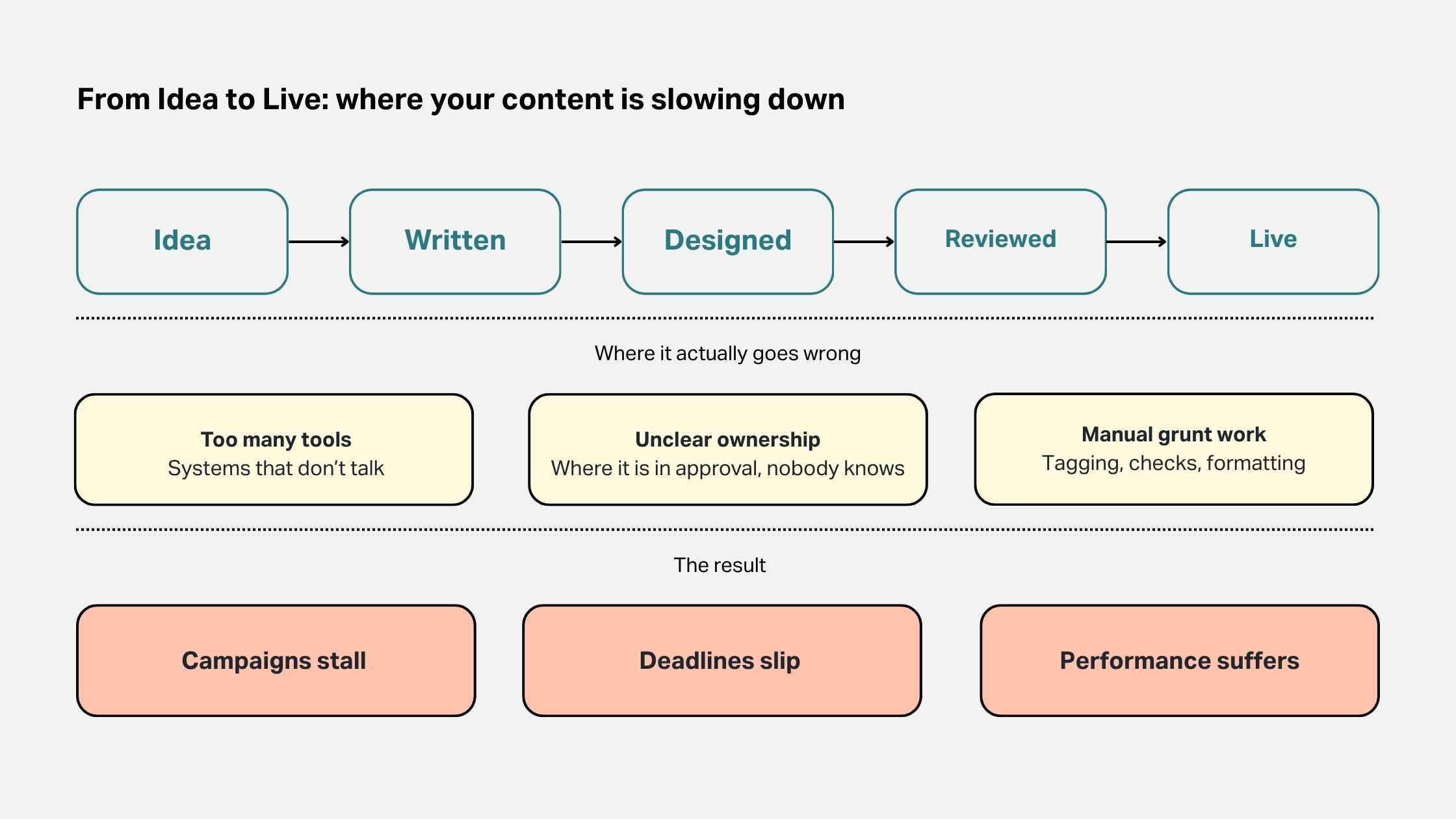
Every piece of content passes through writers, marketers, designers, reviewers, legal, brand and approvers. That's normal. The problem is how badly most systems support this reality. Instead of one clear flow, teams bounce between tools, spreadsheets, inboxes and half-working workflows. Progress slows, frustration builds, and deadlines move from slipping to sliding.
The result is predictable: turnaround times stretch, teams rely on workarounds, quality becomes inconsistent and performance suffers. None of this shows up neatly on a dashboard. But everyone feels it.
What we actually mean by Editor Experience
Editor experience (EX) is the day-to-day reality of creating, managing and publishing content. It's what it feels like to create or update a page, launch a campaign, optimise a piece of content after feedback, personalise at scale, or simply get something live fast.
Good EX means editors can focus on the work that matters. Bad EX means they spend their time fighting the system. EX directly affects marketing performance. When content moves faster, teams can test more, respond quicker and keep things fresh. When it doesn't, everything slows down.
Why content workflows break down
Most content setups weren't designed. They evolved. A CMS here, a DAM there, a project tool bolted on, another approval layer added "temporarily". Over time, the whole thing becomes fragile.
The symptoms are familiar. Too many tools means creating content involves jumping between systems that don't really talk to each other. Too much manual work - tagging, checks, formatting, personalisation rules, localisation - is necessary, but painfully slow when done by hand. Bottlenecks become invisible: content doesn't fail loudly, it just waits, and while it waits, campaigns stall. And the cost per page rises - not just in money, but in time, energy and morale.
This is how teams end up using half a dozen tools to publish one page and still feel behind.
When it's time to fix editor experience
You don't need a crisis to justify looking at EX. But most teams only do when the pain is obvious - usually when technical debt has mounted, an ageing CMS or DXP can no longer keep up, security and compliance pressure is growing, the organisation has changed, or a new content strategy has outgrown the current setup.
If content feels slow and stressful, it's time to review your EX.
How to speed up content by fixing the system
Improving EX means removing friction.
1. Start with the content that matters. Not every page carries the same weight. Focus on the ones that get updated often, support campaigns or drive conversions. Fixing those flows delivers results fast and builds confidence for what comes next.
2. Make ownership clear. Unclear roles create delays. High-performing teams know who creates, who reviews, who approves and who owns performance. Less waiting, fewer loops, faster publishing.
3. Map the workflow honestly. Most teams underestimate how complex their content process has become. Write it down - from idea to live - and then ask where content slows down, what's repeated and what could be automated. This is where platforms like Optimizely CMP make a real difference: workflow isn't bolted on, it's built in.
4. Fix the EX itself. Strong EX means simple, intuitive interfaces, fewer clicks, less context switching, and content, assets and insights in one place. When the system works the way people work, speed follows naturally.
5. Use AI to remove grunt work. AI only helps if it takes effort away, not if it adds complexity. Used well, it can automate tagging and metadata, support SEO optimisation, enforce brand and compliance rules, speed up personalisation and testing, and assist content creation without breaking governance. Optimizely's approach here is practical: AI sits inside the content workflow, helping editors move faster without losing control.
Why this matters more than ever
Marketing performance now depends on how quickly teams can act. Teams that can publish faster, test and learn continuously, and update content without drama will always outperform teams stuck waiting for approvals and workarounds.
Editor experience is one of the most overlooked levers in marketing. Fix it, and everything else starts moving again - content gets out quicker, teams breathe easier and results improve.
Not magic. Just better workflows.
We make technology work for everyone